
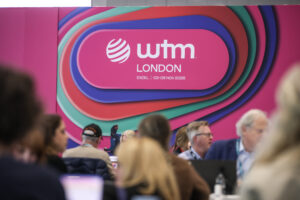
Last week, more than 46,000 people from the global travel industry came to ExCeL London for this year’s World Travel Market. Our team was there – talking to airline partners and travel brands about what to look out for in 2027.
WTM London always lands at the end of the year, and that isn’t just a happy accident. It works a bit like a crystal ball for what’s coming up and what to look out for in travel for the following year. We’re already well into planning 2027, and the trends WTM highlighted are the ones we’re hearing in those conversations. Here are the five we’d pick out.
- Europe is having its short-haul moment
The WTM Global Travel Report, produced with Tourism Economics and released on the opening day of WTM London, forecasts a record 1.57 billion international arrivals in 2026, with Europe up 5%. Short-haul travel is rising as safety concerns, higher fares and reduced capacity take their toll on long-haul trips. Value is steering decisions too: one in six travellers chose their last international destination on value for money, up from around one in eleven in 2025.
Our airline partners are already ahead of this curve. Wizz Air expects capacity growth of nearly 30% this fiscal year, and Spain and Italy are getting new bases: its first in Spain at Madrid and Valencia, a seventh in Italy at Turin, and another at Santiago de Compostela from February 2027. Cyprus Airways is adding year-round routes from Larnaca to Rome and Munich this winter, followed by Cairo and London in spring 2027.
- People are travelling for events
The report found that 58% of international travellers have taken a trip abroad specifically to attend an event in the past two years. Superstruct Entertainment, which owns more than 80 festivals across Europe and Australia, took part in WTM London’s passion tourism panel. It shared that 80% of international visitors to its Awakenings festival in the Netherlands wouldn’t have visited the country without it. WTM’s coverage reported that Visit Philadelphia’s free Fanfest was the most attended event of the FIFA 2026 World Cup, and that 70% of people who travelled there didn’t have a ticket
For brands wanting to connect with these travellers, that is a powerful pull. A concert, a marathon or a festival gives people a reason to book a flight months in advance, and a reason to stay on and explore.
- Human connection is the new luxury
Natalia Talkowska of Natalka talked about to make people feel, choose and remember in the age of AI. On WTM’s Future Stage, she said that gathering audiences is the new luxury, and urged delegates to offer events where people can connect and “de-tech”. Skift Advisory’s Chase Gray backed this up in his talk on the traveller of 2036. He described luxury as “access not excess” and split travellers into three groups: prestige, enrichment and connection. The connection group is made up of people who put shared experiences with family and friends first.
- Gen Z is spending more on experiences
Since Covid, people have been rethinking how they spend their time and money. According to McKinsey, more than half of Gen Z now say they prioritise experiences over material goods. A 2026 report from insights platform Cafeteria, based on input from more than 900 Gen Z users, describes the approach as “coach flights, Michelin nights”: save on getting there, then splurge on food and culture once you’ve arrived. It’s a trend our airline partners have seen time and time again – and WTM’s research points the same way. Tourism Economics’ Dave Goodger said travellers are reallocating resources and looking to save where they can, and 56% of those surveyed want to combine value and luxury within a trip.
- AI is where trips begin, but trust is still earned
According to the WTM Global Travel Report, the use of AI chatbots for planning international trips has more than doubled, from 10% in 2024 to 24% in 2026, and 36% of travellers say they would trust agentic AI to complete a booking. That rises to 54% of 18 to 34-year-olds, against 18% of those aged 55 and over.
The industry is moving just as fast. The report found that 87% of tourism organisations were using AI in early 2026, with operational efficiency the most effective use at 47%. More than 30% of Expedia Group’s 250 million annual service interactions are now AI-powered, and one speaker on WTM’s Future Stage said businesses need “correct, connected and clear data” to use it properly.
AI is becoming a starting point for inspiration, but the decision still rests on who people trust. WTM’s report shows that trust falls as the stakes rise: 58% of travellers trust AI to search and compare prices, but only 36% trust it to complete a booking. That is where authentic travel media has the edge. In our WIZZ reader survey, with full results coming soon, 81% said they use the magazine for inspiration for a future trip and 91% rated it good or excellent. A real writer’s recommendation, in a magazine people choose to read, is something a chatbot can’t offer.
What does this mean for us? Europe’s short-haul moment is our moment too. Here at LXM Media, we reach more than 220 million passengers a year through our airline and travel partners. If you’d like to talk about how to reach those passengers through inflight magazines, ambient and digital touchpoints in 2027, we’d love to hear from you.